
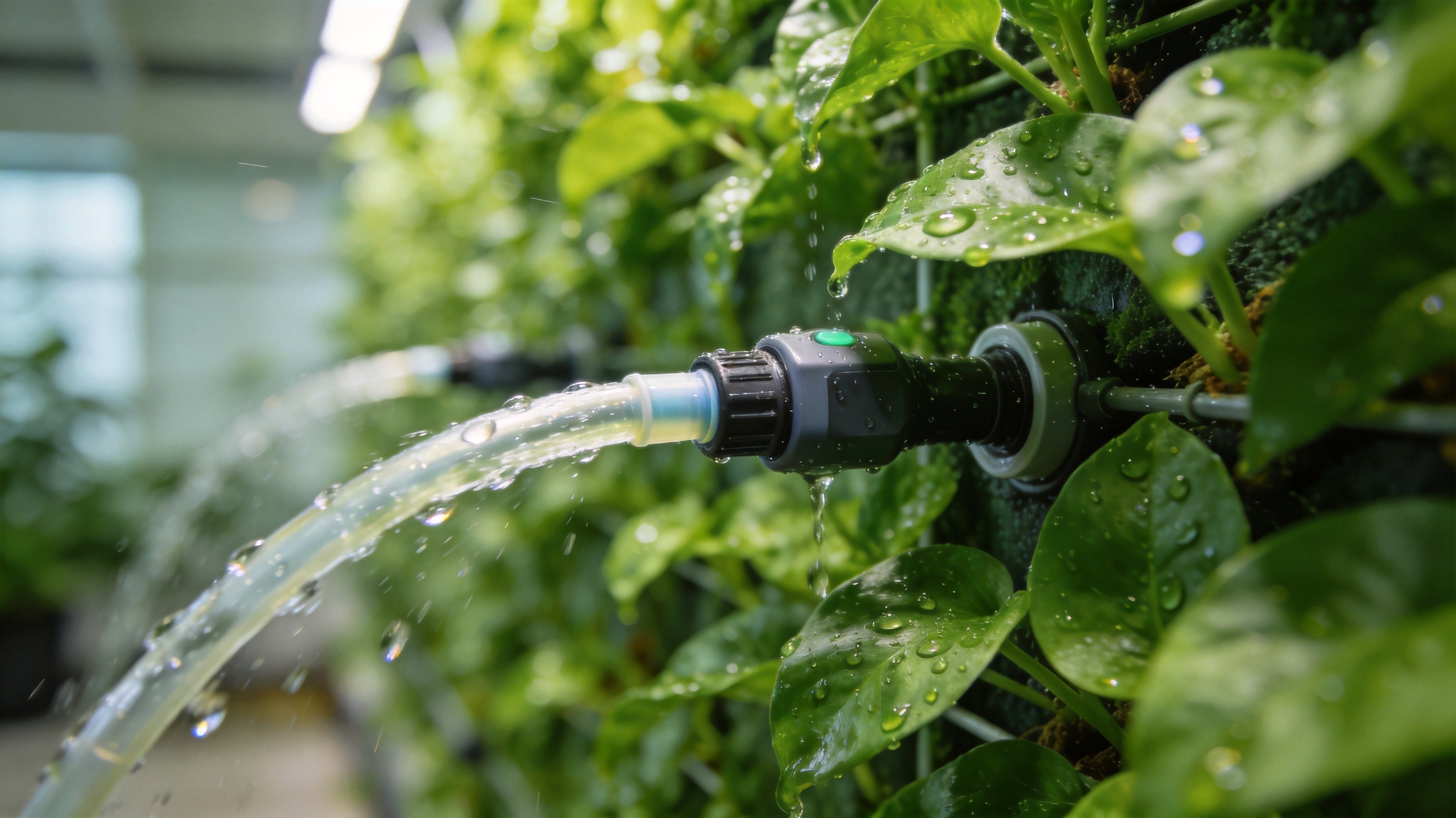
Indoor Green Wall Irrigation: From Manual Drip to Smart Fertigation Systems
The success of any living wall installation hinges critically on irrigation system design. Industry data reveals that over 60% of green wall failures stem directly from improper irrigation—whether waterlogging that suffocates roots or drought stress that withers plants. As vertical gardens evolve from simple decorative installations to sophisticated horticultural systems, the irrigation technology supporting them has advanced correspondingly.
This comprehensive guide traces the technological evolution of indoor green wall irrigation—from basic manual drip systems to cutting-edge smart fertigation—and provides practical guidance for selecting and implementing the optimal solution for your project.
The Unique Challenges of Vertical Irrigation
Gravity and Water Distribution
Vertical environments present physics challenges unknown in horizontal gardening. Water introduced at the top of a living wall flows downward under gravity, naturally concentrating in lower planting pockets while leaving upper sections parched. Research indicates that uncontrolled drip systems can deliver two to three times more water to bottom plants compared to top positions—a disparity that directly impacts plant health and system longevity.
Indoor Environmental Variables
Indoor living walls face dynamic conditions that outdoor systems needn’t consider: HVAC systems alter humidity levels, curtains and blinds modulate light intensity, human activity creates localized temperature variations. These factors compound continuously, meaning irrigation requirements shift throughout the day and across seasons.
According to 2026 agricultural digitalization data, smart fertigation systems increase water and fertilizer utilization efficiency by 30-40% while reducing labor costs by over 25%—making precision irrigation essential for both environmental and economic sustainability.
Irrigation Technology Evolution
First Generation: Manual Drip Systems
Manual drip irrigation represents the most fundamental approach, delivering water through timer-controlled solenoid valves to emitters distributed across the wall surface. While mechanically simple and cost-effective, manual systems demand constant human intervention and cannot adapt to environmental fluctuations.
The primary limitations include: inability to respond to sudden weather changes (summer heat waves may cause afternoon wilting), lack of precision in nutrient delivery, and substantial maintenance requirements for cleaning clogged emitters.
Second Generation: Automated Timed Irrigation
Automated timer systems build upon manual drip foundations by incorporating programmable controllers that execute predetermined watering schedules. Current market offerings support one to twelve daily watering cycles with independent settings for each period.
However, timer-based irrigation remains “open-loop control”—the system executes pre-programmed instructions regardless of actual environmental conditions. During extended cloudy periods or sudden humidity spikes, timers continue their preset cycles, potentially causing overwatering. Conversely, extreme summer conditions may demand more frequent irrigation than programmed schedules provide.
Third Generation: Sensor Feedback Control
Sensor technology maturity enabled closed-loop irrigation control. Contemporary systems deploy multiple sensor types:
- Soil moisture sensors: Measuring substrate water content at the active root zone (5-15cm depth)
- Air temperature and humidity sensors: Capturing environmental data for evapotranspiration estimation
- Light sensors: Detecting photosynthetic photon flux density for growth modeling
Academic research demonstrates that IoT smart irrigation achieves 19% yield improvements and 18% water savings compared to manual fertigation—evidence that closed-loop control delivers measurable horticultural benefits.
Fourth Generation: Smart Fertigation Systems
Smart fertigation represents the current pinnacle of irrigation technology, deeply integrating water delivery with nutritional management. These systems automatically blend fertilizers into irrigation water according to plant requirements and growth stages.
Smart Fertigation System Architecture
Perception Layer: Multi-Dimensional Data Collection
Smart systems gather environmental intelligence through comprehensive sensor networks:
- EC sensors: Monitoring nutrient solution electrical conductivity to ensure optimal fertilizer concentrations
- pH sensors: Detecting substrate acidity affecting nutrient availability
- Meteorological sensors: Collecting ambient temperature, humidity, and light intensity for evapotranspiration calculations
Transmission Layer: Reliable Communication
Modern fertigation employs multi-network communication architectures: LoRa networks handle short-range sensor transmission with 1-3km coverage radii, 4G/5G enables remote command delivery, and WiFi supports local system configuration. Data transmission latency typically stays below one second, ensuring responsive control.
Decision Layer: AI-Powered Intelligence
The decision layer functions as the system’s central intelligence. Cloud servers store historical data and apply machine learning algorithms to crop water-fertilizer requirement models, generating personalized irrigation schedules based on plant species, growth stages, and substrate characteristics.
Advanced edge computing continuously refines fertilizer ratios and irrigation timing: adjusting frequency based on light intensity, dynamically modifying nutrient concentrations according to EC readings, and automatically calibrating daily totals across seasonal transitions. After two to three growth cycles, algorithms achieve highly accurate predictive performance.
Execution Layer: Precision Delivery
Water-fertilizer mixing systems: Smart fertigation machines support multiple fertilizer ratios, achieving uniform nutrient solution through precision metering pumps controlling water and fertilizer flow rates independently.
Irrigation execution systems: Drip irrigation, micro-sprinklers, and misting systems operate in conjunction with electric solenoid valves and flow control devices executing decision-layer commands precisely. Vertical garden applications typically employ pressure-compensating emitters ensuring consistent water delivery across all planting positions.
The MiniJungle JungleMat Synergy
The MiniJungle® JungleMat® system provides an ideal substrate platform for smart fertigation through its Xponge® matrix featuring DualFlow™ dual-channel structure: nano-scale water-storage micropores lock in moisture while micron-scale透气 macropores ensure root respiration. This innovative structural design complements precision irrigation technology perfectly:
- Single watering events sustain 30+ days, dramatically reducing irrigation frequency requirements
- Matrix density of only 0.3-0.8 g/cm³—far below traditional soil—ensures abundant root-zone oxygen
- Plant survival rates exceeding 95% minimize replanting maintenance costs
JungleMat’s modular design facilitates irrigation zoning, enabling independent valve and emitter control for each planting zone. The central control system coordinates zones according to species-specific water-fertilizer requirements, implementing precision irrigation with unmatched granularity.
System Design Best Practices
Water Supply and Drainage Planning
Vertical garden irrigation demands comprehensive supply and drainage infrastructure. Water pressure considerations require attention: upper floors may experience insufficient gravitational pressure, necessitating booster pump installation. Drainage systems must prevent water accumulation that fosters mosquitoes and damages wall structures.
Best practice positions collection trays and drainage pipes at system low points, directing excess moisture to building drainage systems. Advanced projects incorporate rainwater harvesting and air conditioning condensate recovery for irrigation use, achieving circular water resource management.
Emitter Selection
Emitters—the terminal execution components of irrigation systems—directly influence delivery uniformity. Vertical applications benefit particularly from pressure-compensating emitters featuring internal elastic diaphragms that automatically regulate outflow despite pressure variations, ensuring consistent water delivery to all plants regardless of position.
Typical emitter flow rates range from 2-4L/H; excessive flow risks substrate waterlogging while insufficient flow extends irrigation duration unnecessarily. Dense plantings may require additional emitter density, with one to two emitters per planting cell recommended.
Filtration Configuration
Contaminants in water sources constitute the primary emitter clogging cause. Systems should incorporate filtration at main-line inlets, with filtration precision typically specified at 120 mesh (125 microns) or higher. Systems utilizing reclaimed rainwater or circulating water require additional sand filtration and UV sterilization to prevent microorganism proliferation.
Operational Excellence
Regular Inspection Protocols
Even the most advanced smart systems require human oversight. Inspection checklists should verify:
- Emitter operation (absence of clogging, dislodgement)
- Pipe connections (leakage, loosening)
- Sensor calibration accuracy
- Plant health indicators
Weekly comprehensive inspections are recommended, increasing to two to three times weekly during extreme weather seasons.
Seasonal Adjustment Strategies
Irrigation strategy should vary seasonally:
- Summer heat: Increase frequency, shorten intervals, consider misting cooling
- Winter cold: Reduce water volume, extend intervals, prevent waterlogging
- Monsoon seasons: Appropriately reduce irrigation, relying on natural precipitation
Emergency Response Planning
Smart systems should include manual override capabilities, enabling basic irrigation continuity when controllers fail or network connectivity drops. Level alarms and pipe pressure sensors should notify maintenance personnel of anomalies promptly.
Conclusion
Indoor green wall irrigation has evolved from simple timer-based mechanisms to sophisticated IoT-integrated smart fertigation systems. These advanced technologies transform plant care from experience-dependent intuition to data-driven precision—enabling consistent, sustainable living wall performance regardless of environmental complexity.
MiniJungle® remains committed to integrating cutting-edge irrigation technology with premium substrate solutions, delivering sustainable, manageable, high-quality vertical greening outcomes for every project.
Related: Indoor Moss Wall Design Guide | Xponge® Products