
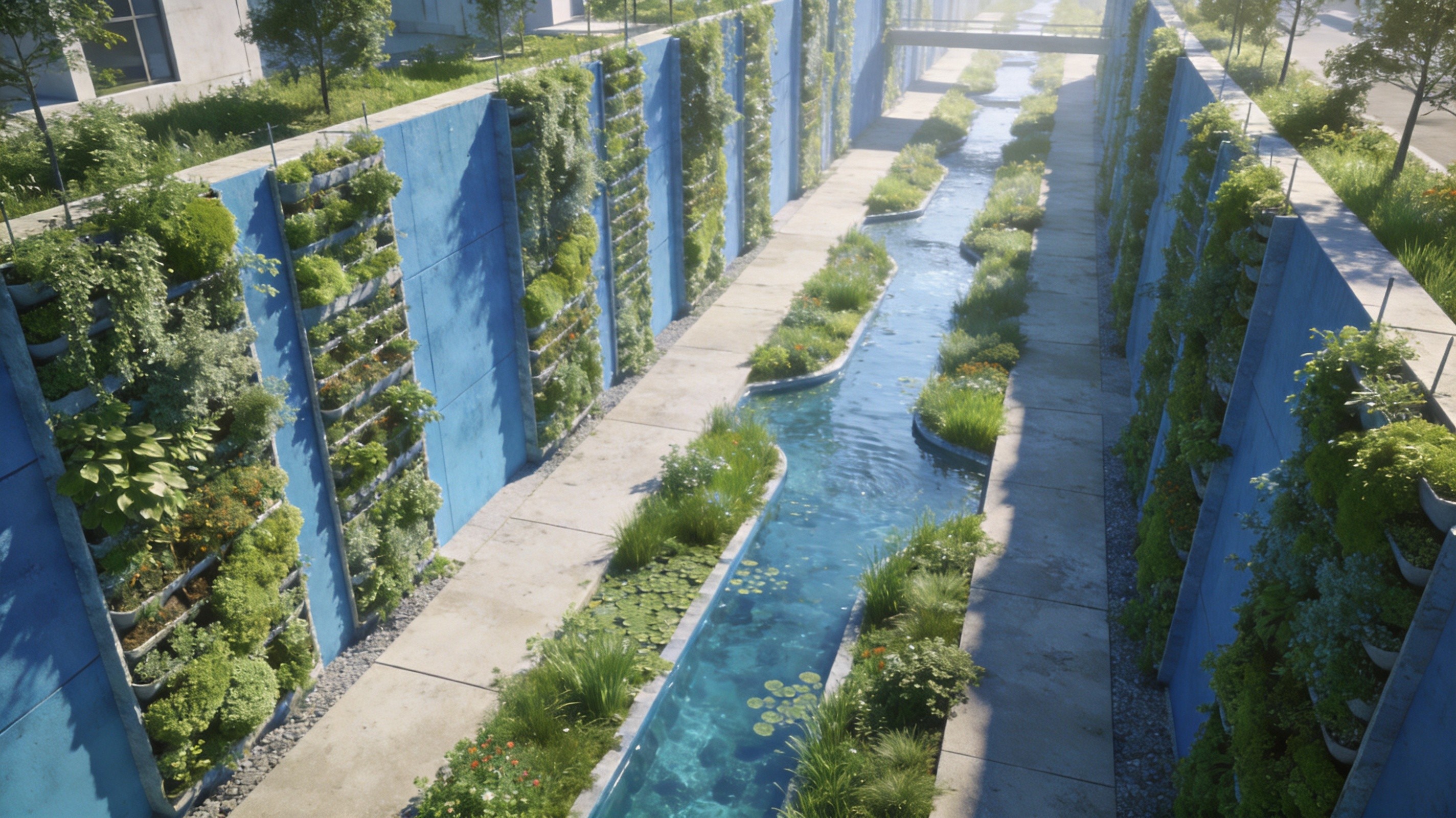
Vertical Greening Meets Sponge City: Rainwater Harvesting and Green Wall Synergy
Global climate change and accelerating urbanization compound urban challenges—flooding, water scarcity, and heat island effects intensify simultaneously. The sponge city concept emerges as a strategic framework addressing these interconnected threats, increasingly adopted by cities worldwide.
Vertical greening—living walls integrated into the urban fabric—serves not merely decorative purposes but functions as essential sponge city infrastructure, enabling rainwater resource utilization and urban heat island mitigation. This comprehensive analysis explores the integration pathways between vertical greening and sponge city principles, providing urban planners and landscape architects with systematic implementation guidance.
Understanding Sponge City Principles
Core Philosophy
The sponge city conceptualizes urban areas as responsive systems—adaptable “sponges” managing environmental fluctuations. The framework operates through six functional principles:
- Infiltration: Permeable surfaces and rain gardens enable precipitation absorption
- Retention: Detention basins and regulatory ponds slow stormwater velocity
- Storage: Harvesting systems capture rainwater for subsequent utilization
- Purification: Natural and constructed wetlands treat contaminated runoff
- Utilization: Collected rainwater supports irrigation, industrial processes
- Drainage: Conduit systems safely convey excess stormwater
Development Context
Since 2015, China’s Ministry of Housing and Urban-Rural Development has promoted sponge city construction nationally. According to China Building Energy Consumption and Carbon Emission Research, building operations contribute 21.9% of national carbon emissions—demonstrating that integrating green infrastructure throughout the built environment can reduce cooling loads 10-30% while advancing carbon neutrality objectives.
Vertical Greening’s Sponge City Role
Rainwater Interception and Retention
Vertical greening systems deliver significant rainwater interception functions:
- Plant canopies directly capture precipitation
- Substrate layers absorb and retain rainfall
- Stormwater entry into drainage systems delays substantially
Research indicates green roofs can delay rainfall runoff by up to 20 minutes—significantly reducing peak drainage system demands during intense precipitation events.
Evapotranspiration and Cooling
Vertical gardens convert retained rainwater to vapor through evapotranspiration:
- Substantial latent heat absorption cools surrounding environments
- Atmospheric humidity increases, improving microclimatic conditions
- Urban heat island intensity diminishes correspondingly
According to Graf Water research, green roofs and vertical greening walls enhance evaporation cooling, effectively reducing urban heat island formation risks.
Water Purification Functions
Vertical greening systems contribute to rainwater purification:
- Foliar surfaces capture atmospheric particulate matter
- Substrate layers filter suspended solids
- Microbial communities degrade organic contaminants
Research documents PM2.5 concentration reductions of 34% in vertical greening zones, with volatile organic compound (VOC) adsorption efficiency reaching 82%.
Vertical Greening Rainwater Collection System Design
System Architecture
Vertical greening rainwater collection and utilization systems comprise interconnected components:
Rainwater Collection Layer
- Growing layer: Plants and substrate directly intercept and absorb precipitation
- Filtration layer: Prevents sediment entry into collection infrastructure
- Drainage layer: Directs excess precipitation to collection points
Storage Subsystem
- Storage tanks/cisterns: Contain harvested precipitation
- Level sensors: Monitor storage status
- Filtration units: Purify stored water
Reuse Distribution
- Pumps: Lift stored water to irrigation systems
- Control systems: Automate irrigation based on moisture sensing
- Drip networks: Deliver water directly to root zones
Design Parameters
Substrate Selection
Substrate constitutes the critical collection system component, requiring:
- Superior water absorption and retention capacity
- Appropriate porosity ensuring adequate aeration
- Minimal weight reducing structural demands
MiniJungle® Xponge® substrate absorbs 10-20 times its own weight while achieving saturated density of merely 0.3-0.8 g/cm³—ideal characteristics for rainwater collection applications.
Drainage Configuration
Systems require rational drainage infrastructure:
- Overflow pipes: Prevent catastrophic overloading
- Drainage gradients: Direct precipitation toward collection points
- Backflow prevention: Eliminate contamination risks
Intelligent Control
Contemporary rainwater collection systems incorporate intelligent control:
- Humidity sensors trigger automated irrigation
- Level sensors monitor storage status
- Rainfall gauges detect precipitation events
- Automatic irrigation source switching
Synergistic Design Strategies
Building Design Integration
Facade Design Coordination
Vertical greening should integrate into building design from conceptual stages:
- Structural capacity and waterproofing accommodation
- Rainwater collection piping system coordination
- Maintenance access and equipment spatial provisions
Roof Garden Coordination
Roof greening and vertical greening systems function synergistically:
- Roof greening intercepts initial precipitation
- Vertical greening processes subsequent runoff
- Combined effect reduces urban drainage burden substantially
Landscape Design Integration
Vertical greening shouldn’t function as isolated infrastructure but integrate into broader landscape design:
- Connections with rain gardens and depressed green spaces
- Continuous sponge landscape corridors
- Balanced ecological function and aesthetic value
Urban Design Integration
Municipal-scale planning should coordinate vertical greening placement:
- Green infrastructure positioning along drainage corridors
- Sponge city green backbone establishment
- Connected ecological network development
Technical Standards and Guidelines
Domestic Standards
Multiple relevant technical standards have emerged domestically:
- Ministry of Housing and Urban-Rural Development: Sponge City Construction Technical Guidelines
- Shanghai: Sponge City Construction Landscape Design Guidelines
- Provincial and municipal technical specifications
Reference Design Parameters
| Parameter | Reference Value |
|---|---|
| Substrate thickness (vertical greening) | 1-5cm |
| Substrate water retention rate | ≥80% |
| Runoff interception rate | 30-70% |
| Annual rainwater utilization rate | 20-50% |
Case Studies
Hong Kong Drainage Services Department
Hong Kong’s Drainage Services Department has constructed 30,000m² of green roofs and vertical greening across water infrastructure facilities, continuing to add 4,000m² annually. This initiative demonstrates:
- Infrastructure greening compatible with urban sponge functions
- Government leadership and demonstration effects
- Mechanisms ensuring continuous advancement
Patent Technology Applications
Numerous vertical greening rainwater collection patents have emerged domestically, such as CN216475934U—a sponge city vertical garden system comprising:
- Building wall connections with subsidiary gardens
- Drainage and overflow pipe systems
- Storage tank and control circuit integration
- Humidity sensor-driven automated irrigation
Under-Bridge Space Utilization
Urban elevated highway spaces—typically dead zones—present opportunities for vertical greening combined with rainwater regulation:
- Pillar triangle zones accommodate vertical greening installations
- Rainwater collection and infiltration facilities integrated
- Under-bridge microclimate improvements
MiniJungle JungleMat Applicability
Technical Advantages
MiniJungle® JungleMat® technology delivers specific sponge city advantages:
Exceptional Rainwater Absorption
Xponge® substrate absorbs 10-20 times its own weight—substantially exceeding traditional soil—enabling substantial precipitation interception and retention.
Lightweight Construction
Compared with conventional greening, JungleMat systems reduce self-weight by 75%, enabling direct installation on building facades without major structural reinforcement.
Modular Maintenance Access
Modular design facilitates pre- and post-rainy-season inspection and maintenance, ensuring optimal system performance throughout the year.
Application Scenarios
- Building facade vertical greening
- Bridge and overpass greening
- Retaining wall vertical greening
- Roof garden edge treatments
Future Development Trajectories
Functional Integration
Vertical greening will merge with additional functions:
- Noise barrier greening systems
- Photovoltaic-greening integration
- Intelligent monitoring-greening combinations
Intelligent Technology Applications
IoT and artificial intelligence will penetrate deeply:
- Real-time monitoring of rainwater collection and utilization efficiency
- Intelligent prediction and dispatch optimization
- Data-driven operational refinement
Standardization Advancement
Accumulating practice will generate refined standards:
- Sponge benefit quantification and assessment methodologies
- Design specifications and quality standards
- Maintenance management and performance evaluation systems
Implementation Recommendations
Planning and Design Phases
- Incorporate vertical greening into sponge city master planning
- Conduct sponge benefit calculations and target decomposition
- Select plant species adapted to local climate conditions
Construction Phase
- Select mature rainwater collection technologies
- Enforce rigorous construction quality control
- Conduct thorough concealed work acceptance
Operations and Maintenance Phases
- Establish regular inspection and maintenance protocols
- Monitor system operational efficiency
- Pursue continuous optimization
Conclusion
Deep integration between vertical greening and sponge city principles represents a significant direction for future urban green infrastructure development. Through scientific synergistic design, vertical greening transcends urban decoration to function as essential infrastructure supporting climate adaptation and sustainable urban development.
MiniJungle® remains committed to advancing JungleMat technology, collaborating with urban planners, building designers, and landscape architects to construct cities that breathe like sponges—achieving harmonious coexistence between greenery and urban life.
Related: Indoor Moss Wall Design Guide | Xponge® Products