
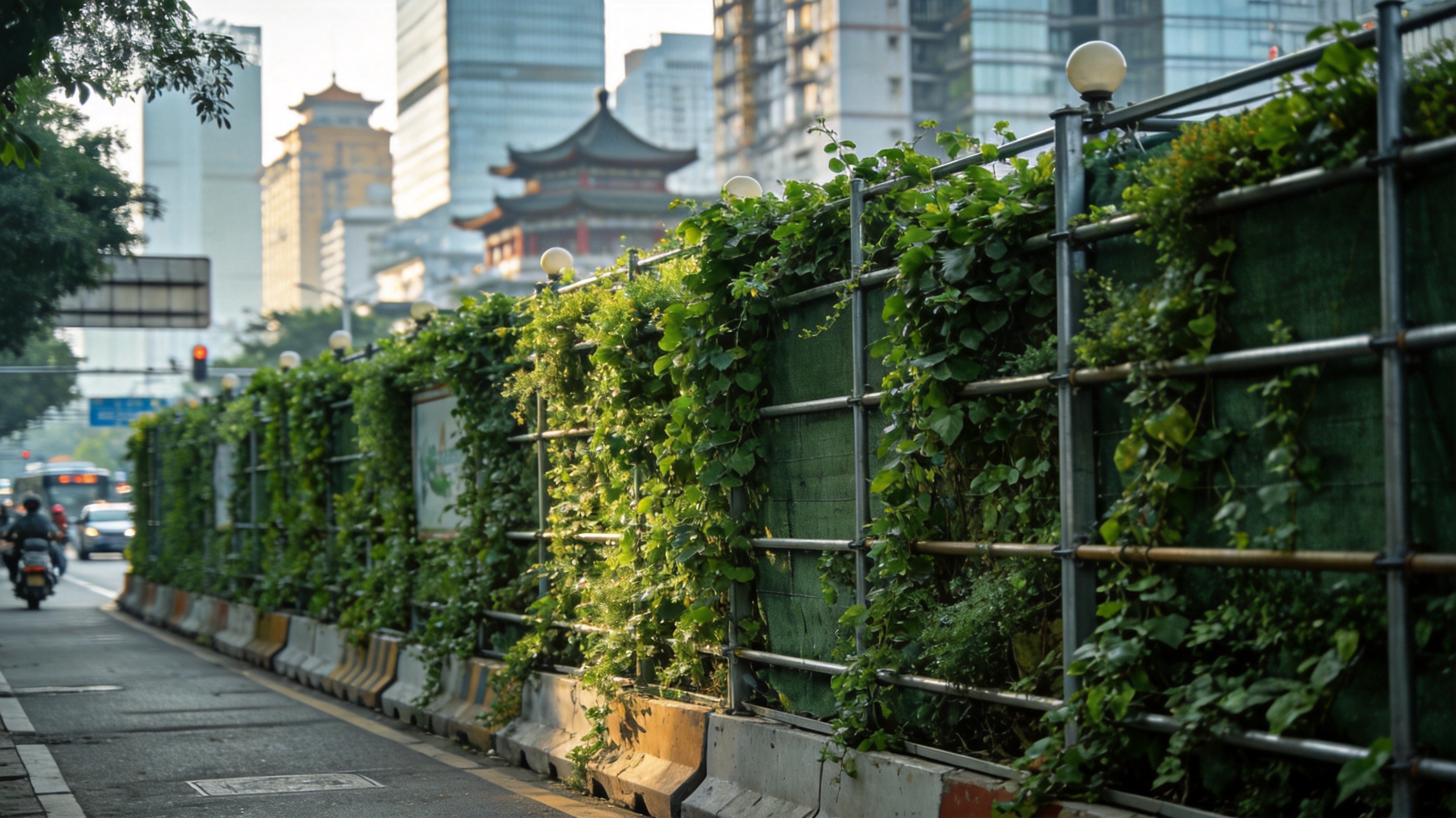
Construction hoarding greening has long been a challenge in urban landscape management — short project timelines, complex environments, and difficult maintenance often lead to visible decline after just 1-3 months with traditional greening methods. The Guangzhou Liwan Fangcun project offers a different answer with the Xponge® soilless JungleMat system.
Project Overview
Located in the Liwan district of Guangzhou, this municipal construction hoarding greening project covers approximately 1,000㎡ with a hoarding height of about 2 meters. Completed in November 2024, the project has demonstrated remarkable stability compared to traditional hoarding greening solutions that typically decline within 3-6 months.

Core Technology: Xponge® JungleMat System
The project employs the Xponge® soilless growth medium combined with the JungleMat planting system. The JungleMat serves as the plant growth carrier, supplying continuous water and nutrients through a drip irrigation system.
Xponge® material maintains approximately 30% air porosity even when fully saturated, providing a stable breathing environment for root systems and preventing root rot. Roots can freely extend across the material surface, keeping plants in optimal growing condition.
Why Traditional Hoarding Greening Fails
Through extensive industry observation, we’ve identified three key pain points that plague traditional hoarding greening solutions:
1. Growing Medium Issues
Traditional soil or amended soil substrates are heavy (80-120kg/㎡), easily compacted after watering, and prone to erosion during rainfall — leading to nutrient loss and system blockages.
2. Irrigation System Problems
Many low-cost projects use simple manual watering or basic drip systems without precision control. Uneven watering causes drought stress in some plants and root rot in others, while poor filtration leads to emitter clogging within months.
3. Poor Plant Selection
To cut costs, many projects use single species or fast-growing plants. Monocultures have weak pest resistance, while fast-growing plants quickly become overgrown and leggy after 2-3 months, dramatically reducing aesthetic value.
Advantages of the JungleMat System
| Advantage Dimension | Technical Feature |
|---|---|
| Modular Installation | Custom planting structures with hanging installation, flexible for different hoarding types |
| Lightweight Structure | Total weight approximately 50kg/㎡ when saturated, reducing structural load requirements |
| Water Efficiency | Closed drip irrigation system with 90% water utilization rate |
| Longevity | Stable landscape effect maintained for 3+ years with proper maintenance |
| Low Maintenance | Automated irrigation reduces manual maintenance by 70% |
Plant Selection Strategy
Plant selection is critical for successful hoarding greening. Based on years of project experience, we follow four key principles:
- Native species first — Locally adapted plants have higher survival rates and lower maintenance requirements
- Strong root systems — Plants with robust root systems better absorb water and nutrients in limited growing space
- Layered composition — Using upper, middle, and lower plant layers creates rich visual depth
- Moderate growth rate — Plants that grow neither too fast nor too slow maintain optimal appearance with minimal pruning
In the Liwan project, we used a combination of Bougainvillea, Schefflera octophylla, Alpinia zerumbet, and Hymenocallis littoralis — creating year-round greenery with seasonal flowering accents.
Construction Process
- Structural assessment and mounting rail installation
- JungleMat module prefabrication in factory
- On-site module hanging and connection
- Irrigation system installation and testing
- Planting and initial maintenance
The modular approach allows 1000㎡ of hoarding greening to be installed in just 5-7 days, significantly reducing construction time and on-site disruption.
Maintenance Guidelines
To maintain long-term landscape quality, we recommend:
- Weekly inspections — Monitor plant health, irrigation function, and structural integrity
- Smart irrigation — Automated systems adjusted seasonally (1-2 times daily in summer, every 2-3 days in winter)
- Quarterly pruning — Maintain plant form and encourage bushiness
- Semi-annual fertilization — Slow-release fertilizer in spring and autumn
- Integrated pest management — Prevention-first approach with biological control methods
Cost-Benefit Analysis
While initial investment in quality hoarding greening may be higher than traditional painted hoardings, the long-term value proposition is compelling. When calculated over a 3-year lifecycle, quality green hoardings actually cost less per year than repeatedly replacing painted ones.
Beyond direct costs, green hoardings deliver significant indirect benefits: enhanced brand image, improved air quality, noise reduction, and positive community relations. In vertical greening industry evaluations, green hoardings consistently outperform traditional alternatives in both aesthetic and functional value.
Project Value
The Liwan project was recognized as an “Excellent Hoarding Greening Demonstration Project” by Guangzhou city authorities in 2024. It has become a benchmark case for municipal greening standards, attracting visits from multiple city administrations and industry peers.
This technology system isn’t limited to hoarding greening — it’s equally applicable to slope restoration, roof greening, and tunnel portal greening projects, with proven reliability across hundreds of installations.
Learn more about professional vertical greening solutions by visiting MiniJungle® — your trusted partner for innovative green infrastructure.
Related: Indoor Moss Wall Design Guide | Xponge® Products