
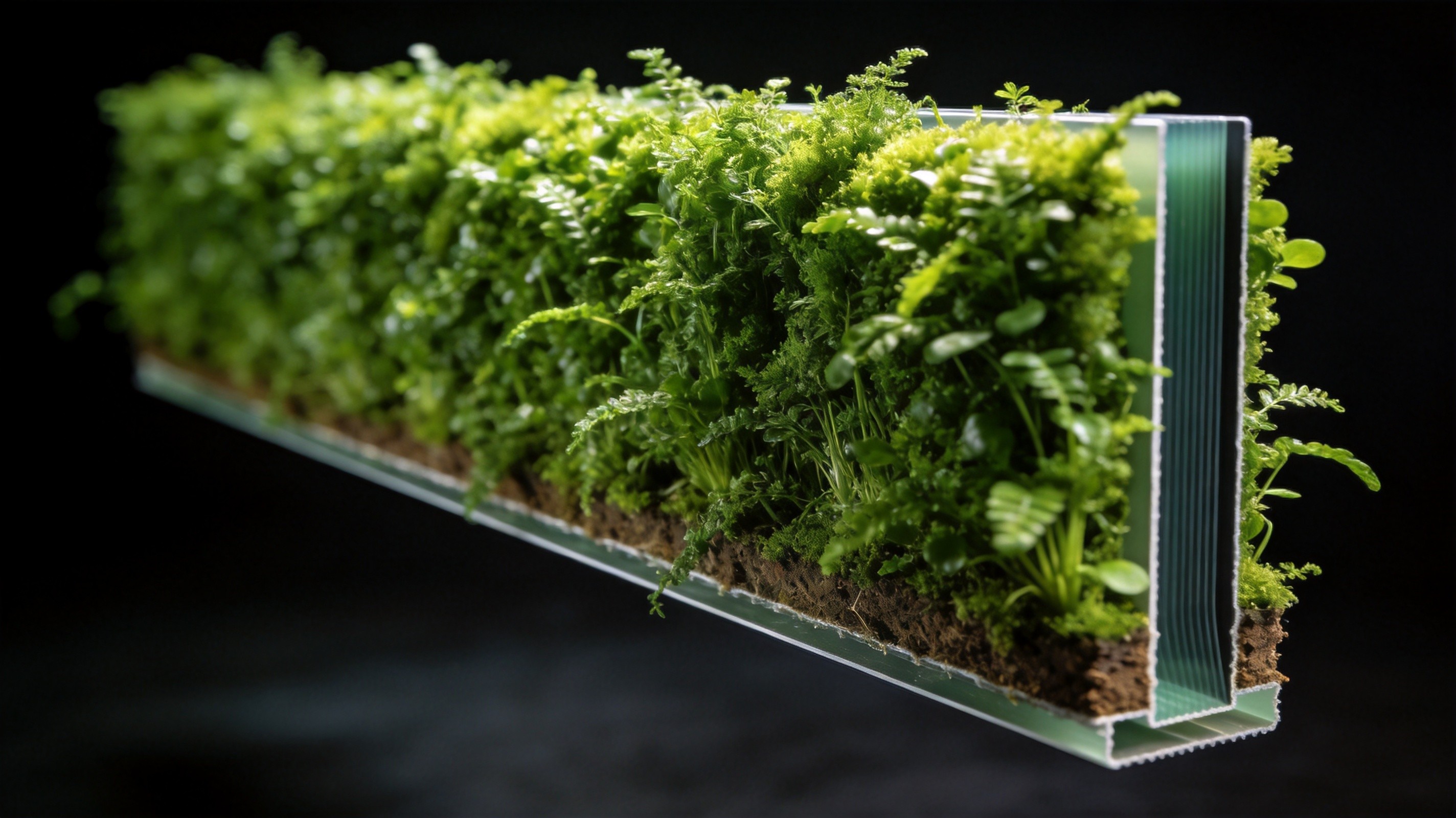
In the world of living walls, thickness has always been a given. Fifteen centimeters. Twenty. Thirty. The industry accepted these dimensions as immutable facts of biology—plants need substrate depth for root development, substrate needs mass for water retention, and water is heavy.
JungleMat® from MiniJungle® rejects these assumptions. At just 1 centimeter thick, JungleMat® is not a thinner version of existing living wall systems. It is a different category entirely—one that makes vertical greenery accessible in places, and at scales, previously unimaginable.
—
## The Weight Problem That Defined a Category
Traditional living wall systems evolved within the constraints of soil-based substrates. These constraints created a cascade of engineering requirements:
| Component | Typical Specification |
|---|---|
| Substrate depth | 15–30 cm |
| Wet weight | 150–600 kg/m² |
| Support structure | Steel or aluminum framework |
| Installation time | 2–6 weeks |
| Required expertise | Specialized contractors |
| Structural modification | Often required |
| Building load assessment | Mandatory |
This is not incidental complexity—it is inherent to the approach. Wet soil is heavy. Heavy substrates require structural support. Structural support requires engineering. Engineering requires time and expertise.
The result is that traditional living walls became capital construction projects: expensive, time-consuming, and requiring specialized knowledge to specify, install, and maintain.
### The Impact on Adoption
This complexity created a market gap. Buildings that could benefit from living walls—the healthcare facility seeking to reduce patient stress, the office building pursuing biophilic design for productivity gains, the hotel creating memorable guest experiences—were priced out or timeline-constrained.
Living walls remained a premium feature for flagship projects. The technology never crossed over into mainstream architecture.
—
## How 1cm Changes Everything
JungleMat® achieves its extraordinary thinness through a fundamental material innovation: replacing soil with Xponge® Matrix technology.
### The Xponge® Foundation
JungleMat® is built on MiniJungle®’s proprietary Xponge® Matrix—a polyurethane-based growing medium that provides:
- Water storage: 10–20× its weight in moisture
- Intelligent release: Roots draw water as needed over 30+ days
- Aeration: DualFlow™ Structure maintains oxygen supply even when fully saturated
- Weight: Wet density of only 0.3–0.8 g/cm³
This combination is only possible through synthetic engineering. Natural materials cannot achieve this performance at any thickness; Xponge® Matrix achieves it at 1 centimeter.
### The Weight Comparison
| System Type | Substrate Thickness | Wet Weight | Structural Requirement |
|---|---|---|---|
| Traditional soil-based | 15–30 cm | 150–600 kg/m² | Steel framework required |
| Rockwool panel | 5–10 cm | 50–100 kg/m² | Reinforced mounting |
| Mat/blanket system | 2–5 cm | 20–50 kg/m² | Standard mounting |
| JungleMat® | 1 cm | 3–8 kg/m² | Direct wall attachment |
The 3–8 kg/m² figure is not a theoretical minimum—it is the specification for fully saturated JungleMat® with mature plant material. This weight can be supported by standard wall construction: drywall, plaster, concrete block, existing finishes.
—
## From Construction to Installation
The most profound shift JungleMat® enables is not technical—it is philosophical. Living walls transition from construction projects to installation work.
### Traditional Process
- Structural engineer assesses building
- Steel framework designed and fabricated
- Waterproofing layer installed
- Framework erected
- Substrate panels installed
- Irrigation system plumbed
- Plants planted and established
- Timeline: 4–12 weeks
- Contractor: Specialized living wall installer
### JungleMat® Process
- Wall surface prepared (clean, dry, relatively flat)
- JungleMat® panels applied (like wallpaper)
- Irrigation supply connected
- Plants inserted into pre-cut pockets
- Timeline: 1–3 days
- Installer: Standard finishing contractor
The comparison is not hyperbolic. JungleMat® is genuinely installed the way wallpaper is installed: adhesive backing, panel-by-panel application, trimming at edges. The skills required are finishing trades skills, not construction skills.
—
## The Paradigm Shift: Who Can Install
This installation methodology change has a profound practical implication: most JungleMat® projects do not require specialized contractors.
Standard wall-finishing contractors exist in every market. They have the tools, the training, and the availability to handle interior finishing work. With JungleMat®, these contractors can now install living walls without specialized certification or equipment.
This changes the economics fundamentally:
| Cost Component | Traditional Living Wall | JungleMat® |
|---|---|---|
| Substrate material | $50–150/m² | $80–200/m² |
| Structural framework | $80–200/m² | $0 |
| Installation labor | $150–400/m² | $30–80/m² |
| Project management | $30–80/m² | $5–15/m² |
| Total installed | $310–830/m² | $115–295/m² |
*Note: Figures are indicative ranges for reference; actual costs vary by project specification and market conditions.*
JungleMat®’s higher material cost is more than offset by eliminated structural requirements and dramatically reduced installation labor. The total installed cost reaches a range accessible for mainstream commercial and residential projects.
—
## Design Implications
### No Load Restrictions
With only 3–8 kg/m², JungleMat® can be installed in structures that cannot support traditional living walls:
- Historic buildings with limited structural capacity
- Upper floors of high-rise buildings
- Suspended ceiling installations
- Portable/movable partition systems
- Rental properties (no permanent modification)
### Aesthetic Flexibility
The 1 cm profile enables design approaches impossible with bulkier systems:
- Flush-to-wall installation: Living walls that do not project into room space
- Curved surfaces: Flexible JungleMat® can follow non-flat geometries
- Integrated lighting: Slim profile allows standard fixture spacing
- Minimal visual intrusion: For installations where the wall should complement rather than dominate
### Scale Range
JungleMat® scales both up and down:
- Feature wall: A single accent wall, 2–10 m²
- Full room installation: 20–100+ m² of continuous coverage
- Building facade: Exterior applications in protected environments
- Ceiling planes: Overhead planting without structural concern
—
## Technical Specifications
### Physical Properties
| Parameter | Specification |
|---|---|
| Thickness | 10 mm (1 cm) |
| Weight (dry) | 0.5–1.5 kg/m² |
| Weight (saturated) | 3–8 kg/m² |
| Standard panel width | 500 mm |
| Standard panel length | Custom (typically 1,000–3,000 mm) |
| Water storage capacity | 3–6 L/m² |
| Irrigation interval | 30–60 days (passive); continuous drip for high-demand applications |
### Plant Compatibility
JungleMat® supports a wide range of plant material:
- Ferns: Ideal for shade and filtered light
- Herbs: Culinary and ornamental varieties
- Succulents: Low-water applications
- Tropical foliage: Philodendron, Pothos, Anthurium
- Flowering plants: Begonia, Impatiens, Streptocarpus
- Moss: Preserved or living for accent areas
The selection depends on light availability, humidity conditions, and maintenance capability rather than substrate constraints.
—
## Maintenance Reality
Living wall maintenance is often underappreciated in the sales process. JungleMat® addresses this through its Xponge® Matrix foundation:
Watering: Drip irrigation systems connect to standard plumbing or reservoir feeds. No daily attention required.
Fertilization: Slow-release nutrients integrated into the matrix or liquid feed through irrigation.
Plant replacement: Individual plants removed and replaced without disturbing adjacent material. No substrate collapse.
Pest management: Sterile growing medium eliminates soil-borne pests. Standard IPM protocols apply to above-ground threats.
Longevity: Matrix does not degrade, compact, or require replacement.
—
## Case in Point: Where JungleMat® Goes
The thin-profile living wall enables installations previously impractical:
- Corporate headquarters: Break rooms, meeting spaces, reception areas
- Healthcare facilities: Patient rooms, waiting areas, rehabilitation spaces
- Hospitality: Hotel lobbies, restaurants, guest rooms
- Retail: Brand environments, window displays, in-store installations
- Residential: Living rooms, bathrooms, balconies, patios
- Education: Classrooms, libraries, student centers
In each case, the reduced cost, simplified installation, and minimal structural requirement make living greenery viable where it previously was not.
—
## The New Standard
JungleMat® at 1 cm is not an incremental improvement to existing living wall technology. It is a different approach—one that prioritizes accessibility, affordability, and integration over raw performance metrics.
For projects where the ultimate density of plant material matters, traditional systems remain appropriate. But for the vast majority of applications—offices, hotels, homes, shops—JungleMat® offers a simpler path to biophilic design.
The question is no longer: Can we support a living wall here?
The question is: Where do we want greenery that we didn’t think was possible?
—
About MiniJungle®
MiniJungle® develops advanced materials for living plant applications. The company’s proprietary Xponge® technology platform enables plant growth without traditional soil, opening new possibilities for biophilic design in architecture, interiors, and consumer products.
Explore JungleMat® specifications and installation guidelines at minijungle.org